
What Is Efflorescence on Exterior Stucco?
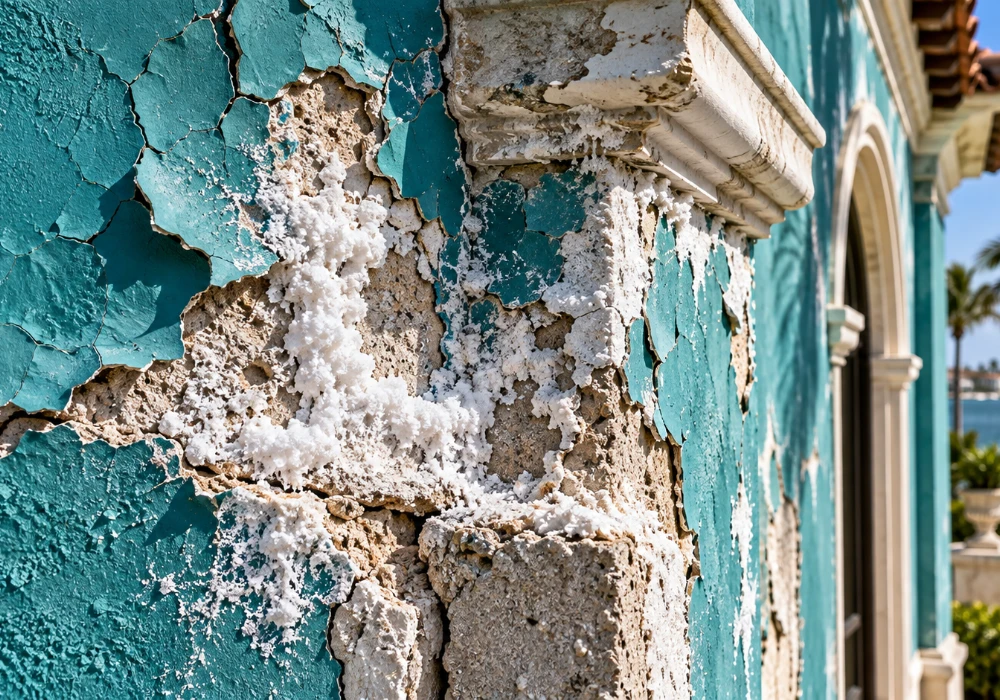
If you notice a white, powdery substance appearing on your exterior stucco, it may not simply be dirt or fading paint. That residue is often efflorescence, a visible sign that moisture is moving through the masonry.
Efflorescence occurs when water travels through porous masonry, dissolves water-soluble salts inside the material, and carries those salts toward the surface. As the moisture evaporates, the minerals remain behind as a white or chalky deposit. Florida’s property-owner guidance identifies efflorescence as a common masonry condition and recommends investigating the underlying moisture source rather than simply covering the deposit.
For homeowners near the South Florida coastline, this can become particularly frustrating. Stucco is porous, while the exterior is constantly exposed to humidity, rain, irrigation, intense sunlight, and airborne salt.
The result can look like a simple paint problem:
- White powder or mineral deposits on the wall
- Paint that feels chalky when you touch it
- Flaking or peeling paint around affected areas
- Bubbling or blistering sections of the coating
- Discoloration and recurring stains
- Fresh paint that begins failing again after a short period
The important distinction is that efflorescence is usually a symptom of moisture movement, not the root cause itself. If the source of the moisture is still active, simply scraping the wall and applying another coat of paint may only hide the problem temporarily.
How Salt Air and Moisture Damage South Florida Stucco
South Florida’s coastal climate puts exterior walls through a combination of conditions that can be hard on paint and masonry.
Salt particles carried by coastal air can settle on exterior surfaces and porous materials. At the same time, humidity and rain introduce additional moisture. Salt and moisture together can contribute to premature chalking, fading, peeling, and deterioration of exterior coatings.
For properties within a few miles of the shoreline, that exposure can be especially noticeable. However, coastal influence is not limited to homes directly on the beach. Salt-laden air can travel inland depending on wind and exposure conditions.
Stucco also naturally interacts with moisture. Water can enter through cracks, deteriorated joints, openings around windows, poorly sealed areas, or other pathways. Once moisture moves through the masonry, it can carry dissolved minerals toward the exterior.
That is where homeowners often see the familiar white residue.
The cycle can look like this:
Moisture enters the wall → minerals dissolve within the masonry → moisture moves toward the surface → water evaporates → salts remain behind → efflorescence appears → the coating loses adhesion → paint begins to peel.
This is why treating the visible paint failure without investigating moisture can produce disappointing results.
South Florida’s climate also combines moisture with strong UV exposure. Over time, sunlight breaks down paint binders and produces chalking, leaving a powdery layer on the surface. If a new coating is applied over loose chalk, the new paint may bond to the unstable layer instead of the underlying stucco.
Why Stucco Paint Starts Peeling and Chalking
Not every peeling wall has the same cause. On a South Florida stucco home, several problems can happen at the same time.
Moisture migration can push against the coating from behind. As water moves through the substrate and evaporates, mineral deposits can accumulate beneath or on top of the paint film.
Surface chalking happens when UV exposure degrades the paint’s binder. The surface becomes powdery, and the coating gradually loses its ability to hold together.
Salt contamination can leave deposits on the surface that interfere with proper adhesion if they are not removed before repainting.
High alkalinity is another consideration, especially when working with new or recently repaired cement-based surfaces. Stucco and masonry can be highly alkaline, so the primer and coating system need to be compatible with the substrate.
Trapped moisture can create another failure point. Painting over a damp surface can seal moisture beneath the coating, contributing to blistering, bubbling, peeling, and premature coating failure.
This is why a successful exterior repaint is not simply a matter of choosing a new color.
The condition of the wall determines what needs to happen before the paint is applied.
If a wall is already showing efflorescence, peeling, or heavy chalking, the first question should be:
Why is the coating failing?
Only after that question is addressed should the new coating system be selected.
How to Diagnose Moisture-Related Paint Failure
Before repainting stucco, homeowners should look beyond the areas where the paint is visibly peeling.
Start by looking for patterns.
If white deposits appear repeatedly in the same area, there may be an ongoing moisture pathway behind the wall. Check nearby roof edges, windows, doors, hose connections, irrigation, downspouts, landscaping, and areas where water regularly collects.
The lower portions of exterior walls can also deserve additional attention. Poor drainage, irrigation overspray, or water remaining near the foundation can contribute to moisture exposure.
Florida’s property-owner guidance specifically recommends reviewing potential moisture sources when efflorescence is present.
A professional evaluation should also look for:
- Loose or peeling paint
- Chalk residue
- Stucco cracks
- Previous patching
- Open joints and gaps
- Water staining
- Mildew or algae growth
- Areas with recurring efflorescence
- Signs of moisture intrusion
A pH evaluation can also be relevant when bare, repaired, or freshly applied masonry is involved. Cement-based surfaces can have high alkalinity, and an appropriate alkali-resistant primer can help protect the coating system from incompatibility with the substrate.
Most importantly, primer is not a substitute for correcting an active moisture problem. If water is still entering the wall, painting over the evidence does not eliminate the source.
The Professional Process for Fixing Peeling Stucco Paint
A durable stucco repaint starts with preparation, not the topcoat.
Step 1: Inspect the surface
The first step is identifying the condition of the existing coating and looking for potential moisture sources. Areas with peeling, cracking, efflorescence, or heavy chalking require more attention than a wall with stable paint.
Step 2: Remove contaminants
Salt deposits, dirt, mildew, algae, and loose chalk need to be removed before painting. Stucco should be cleaned using a method appropriate for the substrate. Excessive pressure can damage masonry finishes or force water into vulnerable areas, so cleaning technique matters.
Step 3: Remove failing paint
Loose and peeling sections should be scraped and prepared until the remaining coating has a stable edge. Painting directly over loose material does not create a sound foundation for the new finish.
Step 4: Address cracks and surface defects
Cracks and gaps should be evaluated and repaired appropriately before the wall is primed. The objective is to prevent obvious pathways for additional water intrusion and create a more uniform substrate.
Step 5: Allow the surface to dry
This step is easy to underestimate. Moisture should not simply be trapped beneath a new coating. Painting over damp masonry can contribute to blistering, peeling, and premature failure.
Step 6: Apply the appropriate masonry primer
Bare, repaired, chalky, or alkaline areas may require a compatible masonry primer. The specific primer depends on the condition and type of substrate. An alkali-resistant system can be important when dealing with cement-based surfaces.
Step 7: Apply a suitable exterior coating
The final coating should be selected based on the stucco condition, exposure, moisture-management needs, and desired finish. For Florida masonry, breathability and compatibility with the substrate are important considerations.
This process takes more time than simply rolling another coat over the wall, but preparation is what gives the new coating a stable surface to perform on.
Why Breathable Masonry Paint Matters in Florida
Stucco is not a completely impermeable surface. It interacts with moisture and water vapor, which means the coating applied over it needs to be selected with that behavior in mind.
A coating that unnecessarily restricts moisture movement can contribute to problems when moisture is already present in the wall. Conversely, a properly selected masonry coating can provide exterior protection while allowing the wall system to manage moisture appropriately.
This is why breathable exterior masonry paint is an important consideration for Florida stucco homes.
The right system depends on the specific property. There is no single paint product that is automatically correct for every stucco wall.
The condition of the existing paint, substrate, previous repairs, moisture exposure, location, and desired appearance all influence the appropriate coating system.
For coastal homes, the objective is not simply to create a fresh-looking wall. The goal is to create a coating system that is compatible with the masonry and appropriate for the environmental conditions.
If your exterior is already chalking, peeling, or developing white deposits, repainting without addressing those conditions can leave the underlying failure mechanism untouched.
Stucco Exterior Painting in South Florida by ASC Painting
ASC Painting provides exterior painting and related property improvement services throughout South Florida, including Delray Beach, Boca Raton, Boynton Beach, Deerfield Beach, Fort Lauderdale, Pompano Beach, Parkland, Plantation, Miami, and surrounding areas.
Founded in Florida in 2016, ASC Painting has built its business around quality, commitment, and client-focused service. The company has approximately 8 years of experience in the painting industry and has served around 500 customers.
For homeowners dealing with stucco paint peeling in South Florida, the objective is not simply to cover the visible damage. Exterior painting requires attention to the existing surface so that preparation, repairs, primer, and the final coating work together.
ASC Painting also offers waterproofing, which can be relevant when exterior moisture is part of a property’s broader maintenance needs.
Because every property has different exposure and surface conditions, an exterior evaluation can help determine whether the issue is primarily related to paint deterioration, moisture movement, surface preparation, or a combination of factors.
Stop Stucco Paint Problems Before They Spread
White powder on your stucco, recurring chalking, and peeling exterior paint are more than cosmetic issues worth ignoring. They can be signs that moisture, salts, UV exposure, or poor adhesion are affecting the coating system.
The key is to avoid treating the symptom alone.
Cleaning efflorescence without investigating moisture, painting over chalk, or applying a new coating to an inadequately prepared surface can leave the same problem waiting underneath the fresh paint.
For homeowners in Delray Beach, Boca Raton, and other South Florida communities, proper preparation and the right masonry coating system can make a significant difference in how an exterior repaint performs.
If your stucco is showing white deposits, peeling paint, or persistent chalking, contact ASC Painting at (561) 757-9705 to discuss your exterior painting project and determine the next step for your property.